What Happens When Access to Information Becomes a Commodity?
I’ve been thinking a lot about how much of my job used to be shaped by what I could see.
When I was in commercial, I’d often have a question about a customer. What does a good customer look like? How are they using the product? I could ask another team, but there was always some distance between me and the answer. I didn’t think much of it. You get used to working with what you have.
Then I moved into product, and the big surprise was how much more I could see. Usage data, product flows, docs and customer feedback, all right there. Questions I used to ask someone else, I could now look into myself.
It made me realize a lot of the time, the bottleneck was simply access. The information was there. I just couldn’t get to it easily.
That’s changing fast. You can connect a coding agent to usage data and docs and start digging yourself. No need to become a data analyst or an engineer. The gap between having a question and looking into it keeps getting smaller.
I’ve been trying this at work. I take things I’d have asked another team to look into and see how far I get on my own.
The first real test was earlier this year. A small Slack bot that answered questions about how our product works.
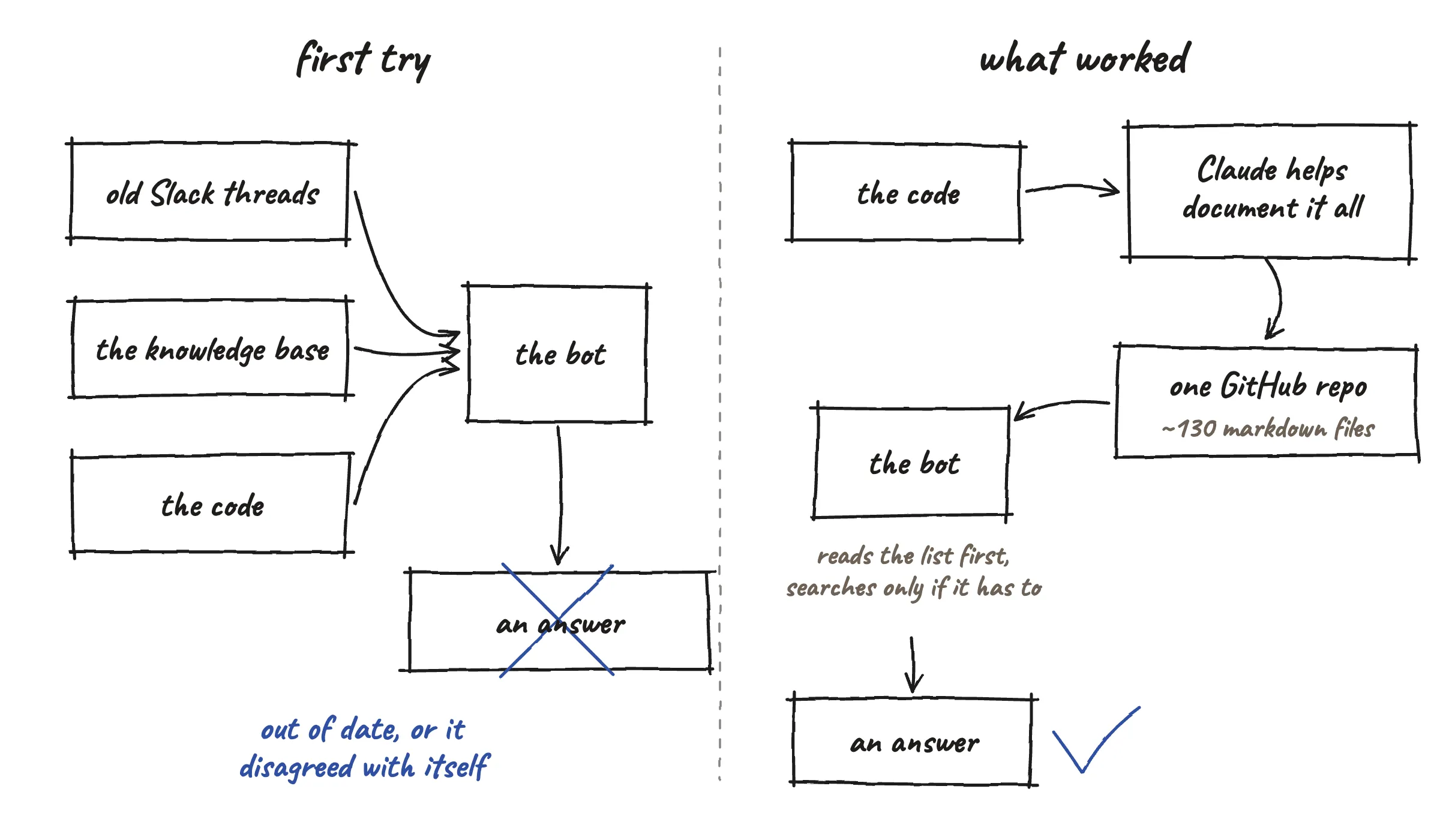
My first try was pointing it at everything. Old Slack threads, the knowledge base, the code. It didn’t work. It kept finding answers that were out of date or disagreed with each other.
What worked was much simpler. We wrote down everything the product does in structured markdown files, all in one GitHub repo. Claude helped write the first version from the codebase, about 130 files, one per part of the product. The bot read that repo, started with the index, and only searched when it had to.
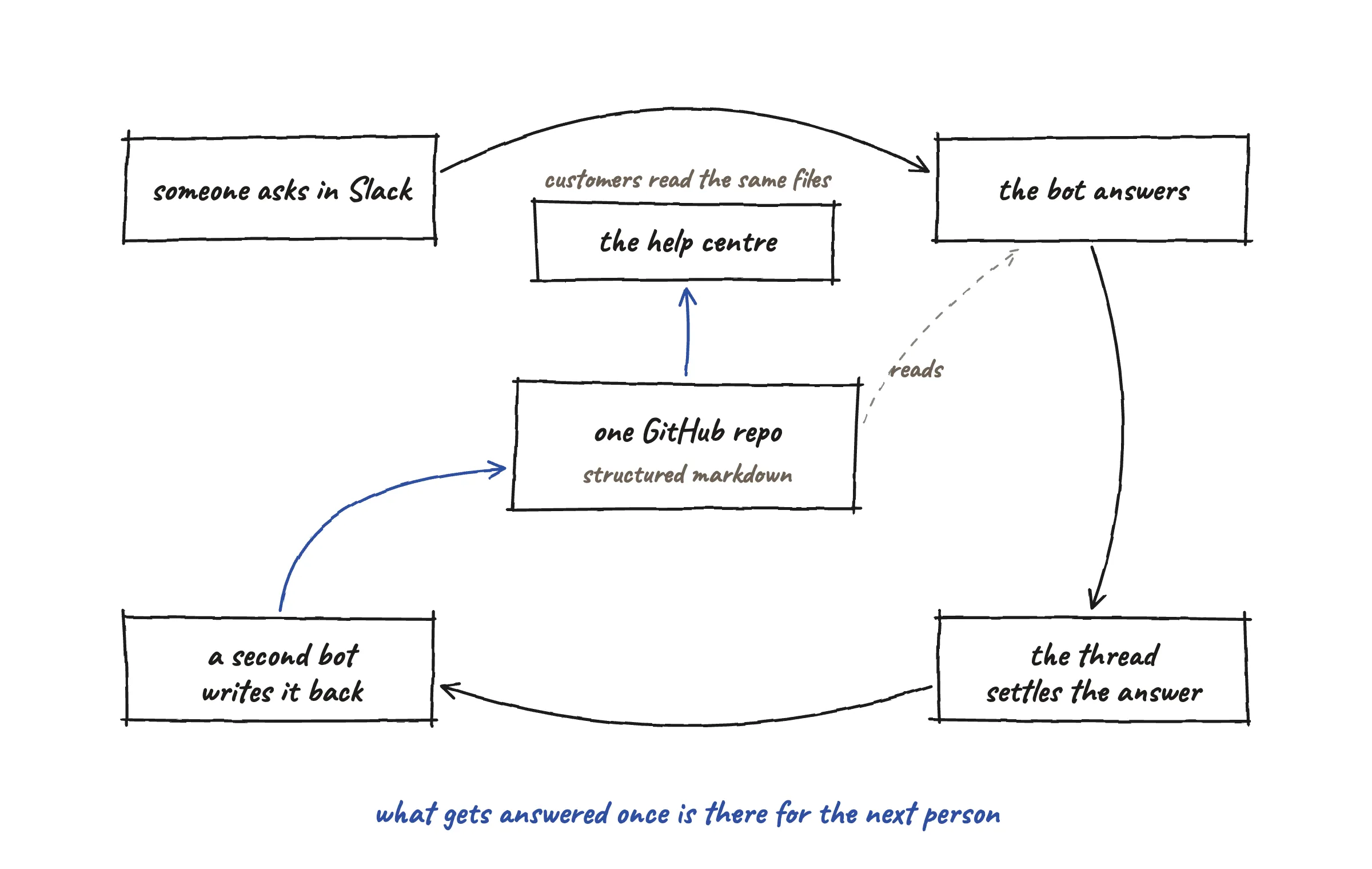
The main lesson was keeping it current. When something new got answered in Slack, a second bot wrote it back into the repo. The same files fed the help center our customers use. A lot of the internal tools I’ve seen die from neglect. This one kept itself up to date as part of how it worked.
We retired it in July, once the product assistant properly took over. What I liked most was that I didn’t have to ask anyone to find out if it would work.
The second experiment was bigger. I’ve started calling it the company brain.
As the company grew, we spent more time explaining past decisions and sorting out different assumptions. And the more work we handed to Claude and Codex, the more they needed that context too.
So we started writing it down. Small pieces, each with one owner, updated whenever a decision changes:
- the product vision and our current bets
- who we build for
- our principles and the domain concepts
- what the product will not become
The point is that people have the right context when they decide something. Why we chose it, what we’ve already tried. And it has to reach people in a form that fits their job. Someone in sales needs different context from someone designing a contract flow, even if it comes from the same place. Claude and Codex get theirs through skills, so an agent on a project starts from the same context a new teammate would.
The company brain took the Slack bot’s lesson with it. Context only stays useful if keeping it current is part of the work.
The bigger change for me is the questions I start asking once I know I can get to the answer. When it’s easy to find things out, you look into stuff you wouldn’t have bothered asking about before.
That got me thinking about how roles are changing. PMs are prototyping. Designers are working in code. And people in commercial roles can get much closer to the product.
Take someone in sales. Picture them with an agent connected to the places I now go for answers:
- Airspeed, Gong or Granola for what was said on their calls
- Metabase or Amplitude for how customers use the product
- Datadog or Sentry for what breaks in production
- the codebase on GitHub for how things actually work
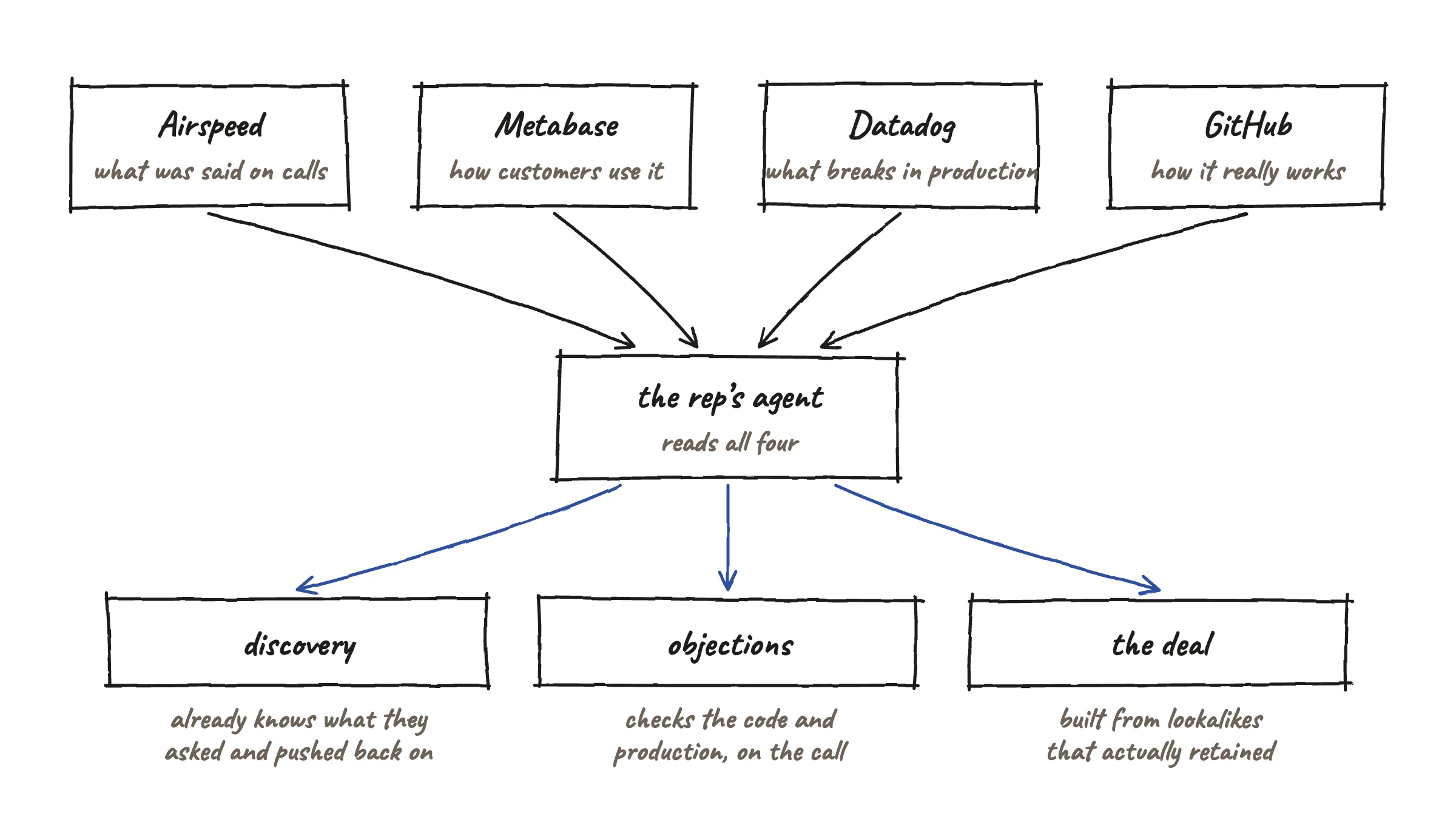
Before a discovery call, the agent has already read the earlier calls with that customer. It knows what they pushed back on and what they said they’d need to see.
When an objection comes up on the call, the rep doesn’t have to promise to come back next week. They can check how the feature really works in the code, and whether customers like this one have had problems with it.
When it’s time to shape the deal, the agent can find lookalikes. Customers with a similar size and setup. It can see which are still using the product a year later, what they adopted first, and where the ones who left got stuck. Then the deal gets built around what kept customers like this one.
Without that context, every one of those answers sits behind a ticket or a meeting. You still talk to product and engineering. You just go less often, with better questions.
Working on quote to cash, I’ve learned that getting paid starts long before a contract is signed.
Every promise made in discovery and negotiation ends up on an invoice. A custom payment term. A discount that was meant to be temporary. If the deal doesn’t match what the product can bill, finance finds out at the first invoice. Usually from the customer.
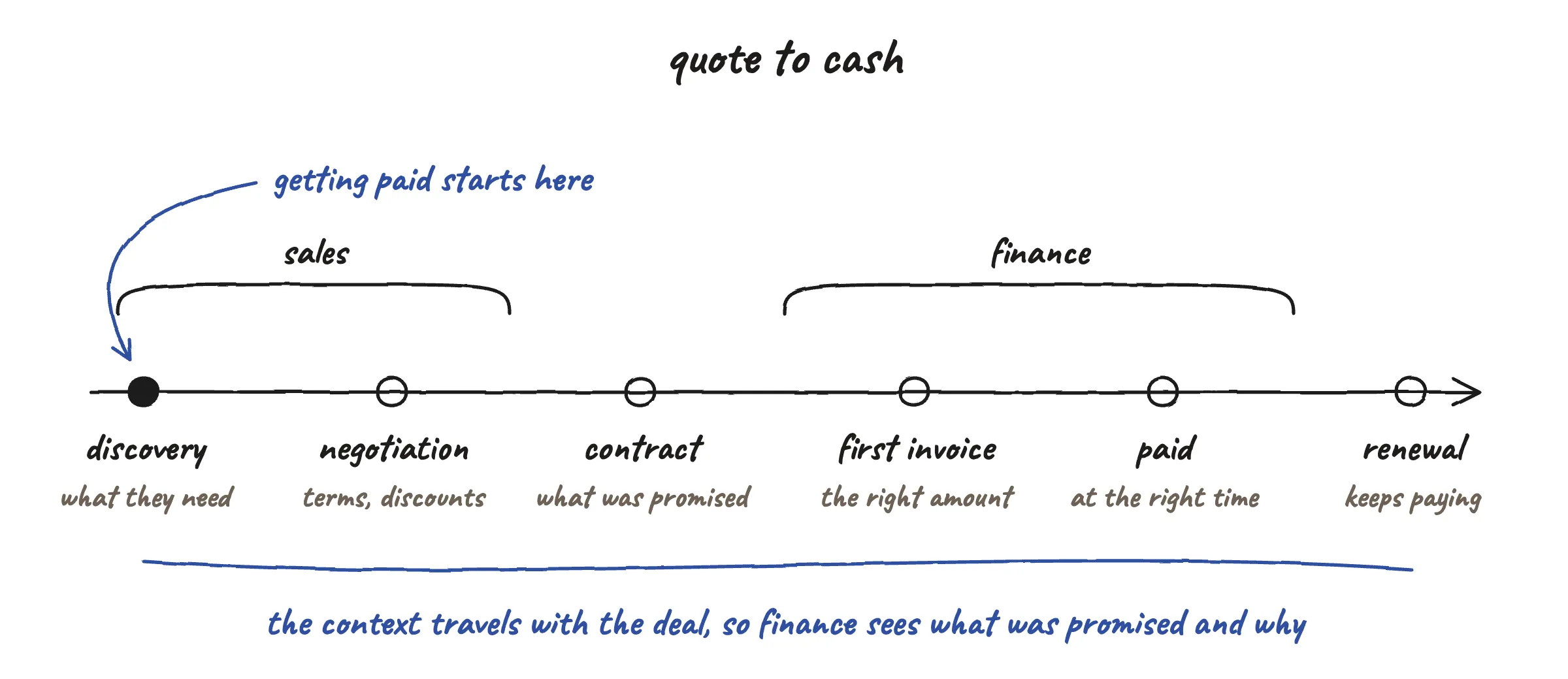
When the rep has the right context, the deal is shaped around what we can deliver and bill. So the first invoice matches what the customer agreed to. The context travels with the deal, so finance can see what was promised and why before that invoice goes out. My guess is the deals built on lookalikes that stayed are also the ones that keep paying at renewal.
Maybe the shift is that more people become builders without becoming technical. They get closer to the thing they work on and look into their own questions.
I’m still figuring out what that means. Next I want the company brain to keep itself up to date, the way the Slack bot’s repo did. I’ll write up how it goes.
The last reader left you this
Leave a note for whoever reads this next.
Read next: The Best Place to Build Might Not Be the Best Place for You · more essays

Written by Kyle Rowley
Founder, operator, former pro basketball player. I write about revenue, building things and sports.
I send one of these most Thursdays, if you’d like to follow along.
If it’s not adding anything, unsubscribing takes one click.
See more from me